
Enterprise headless CMS for marketing & dev teams
Agility is a content management system that helps marketing teams create and publish content faster across every digital channel, while giving developers API-first flexibility to build with any tech stack. It connects with the AI tools your team already uses and has been trusted by enterprise teams since 2003.
Trusted by enterprise teams across North America and beyond




Real outcomes from real enterprise teams



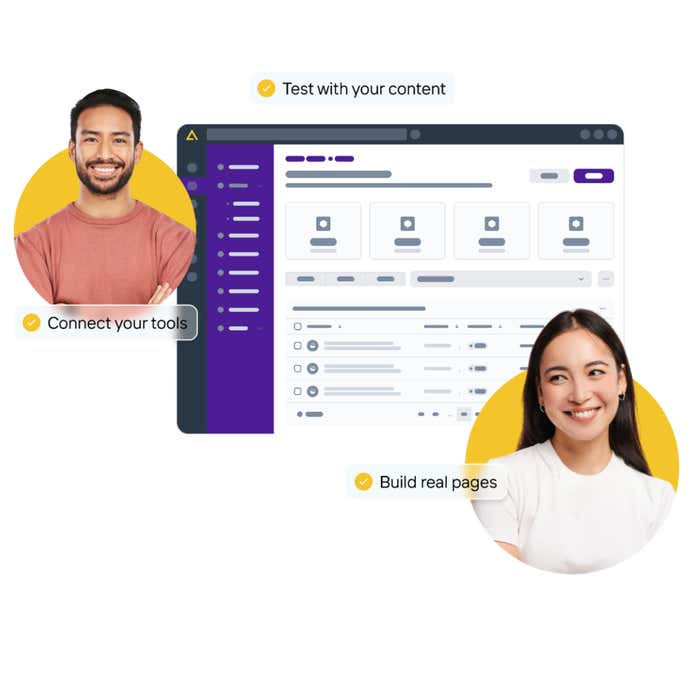
The composable enterprise CMS
Built for every team and every channel
Full developer freedom on any stack
Build on Next.js, Nuxt, Gatsby, Astro, .NET, and more with REST and GraphQL APIs.
Visual page building and omnichannel delivery
Publish once, deliver everywhere, and give marketing teams the tools to launch without developers.
Enterprise security and compliance
SOC 2 Type II certified, GovRAMP registered, with nine built-in roles, SSO, and full audit trails.
Global scalability for multi-site and multi-brand teams
Manage multiple websites, brands, and regions globally from a single Agility CMS instance.
Your team can now manage content through the AI tools they already use
Agility CMS connects directly to Claude, GitHub Copilot, Cursor, and Windsurf. Ask your AI assistant to pull up a content model, create a page, or update content without leaving the tool you are already in. Built on structured content architecture, AI tools get clean and reliable data, not unstructured HTML. Enterprise security and role-based permissions stay in place throughout. Powered by the Agility MCP server with 19 tools and OAuth 2.0 authentication. Learn about the Agility MCP server.
Predictable enterprise pricing, not usage-based billing
Most enterprise CMS platforms charge more as your traffic and content grow. Agility CMS offers fixed pricing that scales with your team and your sites, not your API call volume. No surprise invoices at the end of the month. No renegotiating your contract when your traffic spikes.
Unlike usage-based platforms, Agility CMS total cost of ownership stays predictable from year one to year ten.
Contact the team for a custom quote based on your organization size, number of sites, and requirements.
Agility CMS is a multi-G2 2026 award winner

Launch faster, without the usual migration pain.
Agility CMS is designed for phased migration from any legacy CMS, including WordPress, Sitecore, and Adobe Experience Manager. You can migrate content and channels incrementally while your existing systems stay live. The Agility team has migrated hundreds of enterprise organizations and provides hands-on support through every stage.
CUSTOMER STORIES
What enterprise teams say about Agility CMS
Swipe or use arrows
Common Questions
Questions people ask before choosing Agility CMS.
What makes Agility CMS different from other headless CMS platforms? −
Agility CMS combines full API-first headless architecture with a built-in visual page builder and marketer-owned page management — something pure headless platforms don't offer. Marketing teams can publish independently while developers retain full control of the front end and technology stack.
How is a headless CMS different from WordPress or Sitecore? +
WordPress and Sitecore are traditional coupled CMS platforms where content and presentation are tightly linked. A headless CMS separates the two, delivering content via APIs to any channel. This gives developers framework freedom and allows content to power web, mobile, digital signage, and AI experiences simultaneously.
Can we migrate from WordPress, Sitecore, or Adobe Experience Manager to Agility CMS? +
Yes. Agility CMS is designed for phased migration from any legacy CMS. You can migrate content and channels incrementally, keeping existing systems running while your new architecture comes online. The Agility team has migrated hundreds of enterprise organizations from WordPress, Sitecore, and AEM.
Is Agility CMS enterprise-grade for security and compliance? +
Yes. Agility CMS is SOC 2 Type II certified and GovRAMP registered. It is hosted on Microsoft Azure with a 99.95% uptime SLA. Standard features include role-based access control, nine built-in roles, approval workflows, full audit trails, and SSO via SAML and OAuth.
What front end frameworks does Agility CMS support? +
Agility CMS is fully framework-agnostic. Official starter kits are available for Next.js, Nuxt.js, Gatsby, Astro, and ASP.NET. The REST and GraphQL APIs work with any JavaScript or .NET framework. Agility CMS also provides TypeScript and JavaScript SDKs, a content sync SDK for static generation, and webhook support for CI/CD pipelines. You can deploy to Vercel, Netlify, Azure DevOps, or any custom hosting environment.
How does Agility CMS pricing work for enterprise teams? +
Agility CMS offers transparent, fixed enterprise pricing, not usage-based pricing that escalates with traffic. Unlike usage-based platforms that charge more as traffic grows, Agility CMS offers fixed enterprise pricing. Contact us for a custom quote.
What is a composable DXP and how does Agility CMS support it? +
A composable digital experience platform (DXP) is an architecture where each capability like CMS, personalization, search, commerce, analytics is handled by a best-of-breed service connected via APIs. Agility CMS serves as the content hub at the centre of a composable stack. It is built on Microservices, API-first, Cloud-native, and Headless principles. Marketing and development teams can swap tools in or out without rebuilding the whole platform.
Is Agility CMS a MACH-compliant platform? +
Yes. Agility CMS is MACH compliant, the industry body that certifies platforms built on Microservices, API-first, Cloud-native, and Headless architecture. MACH membership signals to enterprise buyers that the platform will integrate cleanly with other best-of-breed services and does not lock you into a proprietary stack.
How does Agility CMS support omnichannel content delivery? +
Agility CMS stores content as structured data in a central repository and delivers it via REST and GraphQL APIs to any front end. This means the same content model can power your website, iOS and Android apps, digital signage, in-store kiosks, email platforms, and AI-powered interfaces simultaneously. Content is created once and published everywhere, eliminating duplication and version inconsistency across channels.
Can Agility CMS manage multiple websites and brands from one instance? +
Yes. Agility CMS supports multi-site and multi-instance architectures, allowing enterprise teams to manage multiple brand websites, regional sites, and microsites from a centralized content hub. Shared content models and reusable components maintain consistency across properties while each site retains its own content, permissions, and publishing workflows. Oxford Properties Group uses Agility CMS to manage multiple sites at scale.
What AI capabilities does Agility CMS support? +
Agility CMS connects directly to the AI tools your team already uses, including Claude, GitHub Copilot, Cursor, and Windsurf. Developers and content teams can create pages, update content items, manage content models, and handle media assets through natural language inside their AI assistant — without switching to a separate CMS interface. This works because Agility uses structured content models rather than unstructured HTML, which gives AI tools clean, reliable data to work with. Enterprise governance, approval workflows, and role-based permissions stay in place regardless of how or where content is created. Under the hood, this is powered by Agility's Model Context Protocol (MCP) server, currently in beta at mcp.agilitycms.com, with 19 tools and OAuth 2.0 authentication.
See why enterprise teams choose Agility CMS
Get a personalized demo and see how Agility CMS fits your team's publishing workflows, developer stack, and digital channel strategy.